
Identifying Hidden Winter Pipe Damage and Preventing Early Spring Mold
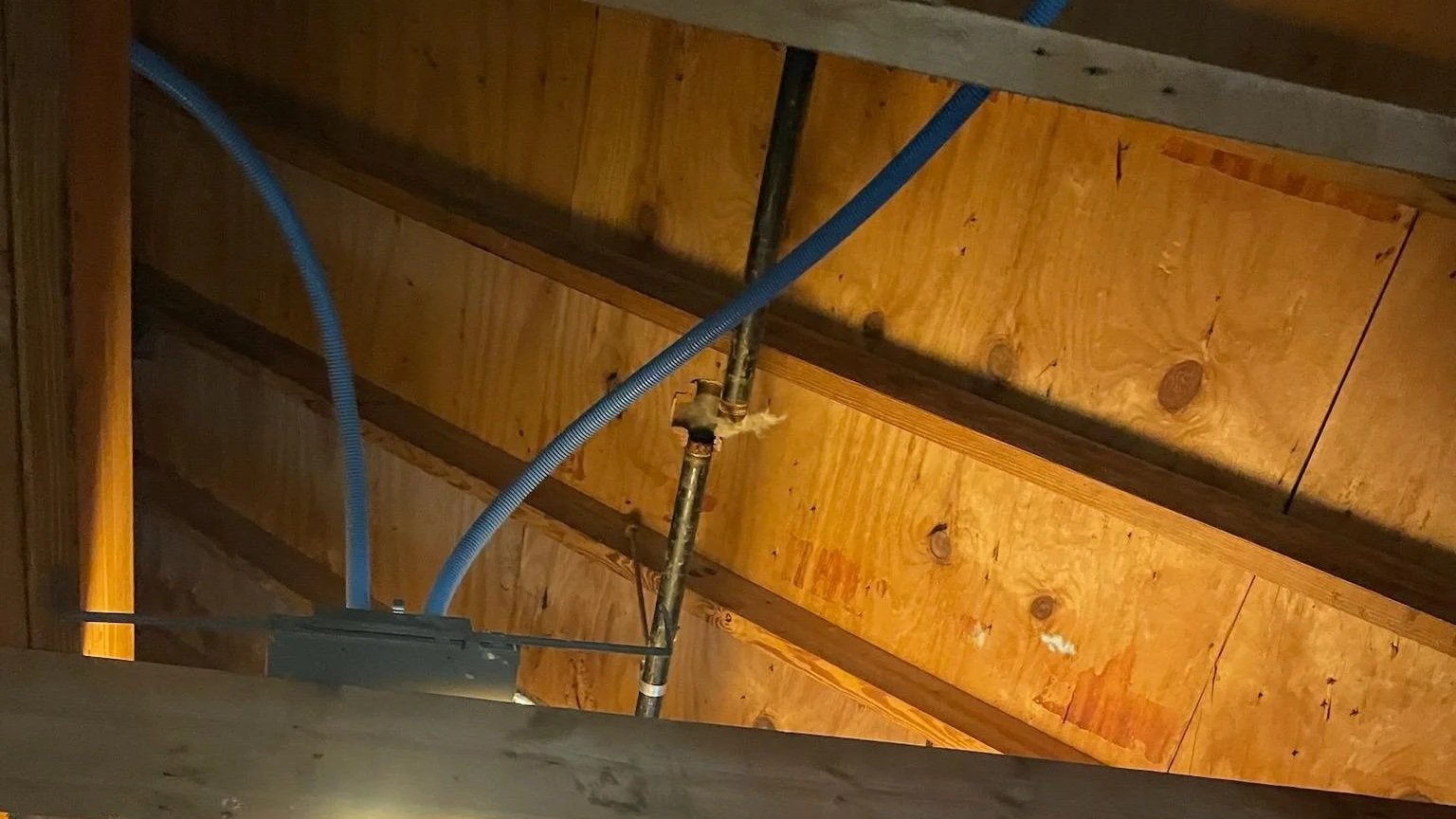
This pipe burst after a freeze causing significant water damage to the building
February in Georgia often sees the tail end of freezing temperatures, followed by significant rain. Small cracks that may have formed during winter’s freezing temperatures can become major leaks if they are not found and addressed.
Water expands as it freezes, which in a contained space like the inside of a pipe creates internal pressure. Ice inside a pipe may cause a plug that does not allow water to flow. The pressure of the ice expanding can cause hairline fractures in the pipe. While the ice is still frozen, water may not leak out. When the ice thaws, the water pressure behind it may cause a sudden rush against the crack, causing it to leak or even burst. Even when the ice thaws and water can flow through the pipe again, the weakened pipe may not leak immediately. Eventually, however, hairline cracks may open as fluctuating water pressure causes the pipe to expand and contract. By the time the leak is discovered, it may have been dripping for days, weeks, or even longer. Water becomes trapped inside wall cavities, ceiling cavities and under flooring, eventually creating a prime breeding ground for mold. Long term water damage is also dangerous because water may spread in drywall and insulation. It also will spread across surfaces like concrete, plywood subflooring, and wood framing. All this traveling causes the affected areas to be much larger than the original leak site. It pays to find these leaks sooner rather than later, so now is a good time to check for hidden water damage.
We often shove cleaners and sponges under the sink, which hides the most vulnerable area: where the pipe enters the wall. Take a dry paper towel and run it along the supply lines and the P-trap (the U-shaped pipe). Any sign of dampness on the towel indicates a failing seal. Pull back the metal escutcheon plate (the ring where the pipe meets the wall). If the drywall behind it feels soft or looks discolored, you probably have a leak inside the wall cavity. Look for warping in the wood at the back of the cabinet and on the floor of the cabinet.
Attic pipes are often the first to freeze because they sit outside the heated areas in your living space. If you have blown-in insulation, look for areas where the insulation is matted down or has settled. Look for signs of water dripping from overhead. Inspect exposed pipes for white, crusty buildup or green corrosion around the joints. These are signs that the joint has been leaking and may burst if not addressed right away. Check any wood flooring for staining or dark rings which are signs of water dripping on the wood.
Outdoor faucets are the most common winter plumbing failure. Check the pipe feeding the spigot. If you hear water running or see leaking in your basement or crawlspace while the spigot is closed, the internal pipe has cracked or ruptured. Look at the siding directly below the spigot. If it is damp or has staining, the pipe may be leaking behind the exterior siding.
The best test for a basement or crawlspace is a sniff test. If it smells musty, you have excess moisture which can be from a fractured pipe. You can also look at the joists. If you see hanging water droplets or water trails along the wood, you have a leak. Because the water may have traveled, the pipe damage may not be right where you are seeing the water.
“Dry" isn't a feeling, it’s a data point. If you find a leak, wiping up the puddle is only 10% of the job. While a wall might feel dry to the touch, the internal studs or insulation could still have as much as 90% saturation. Remember that it is the hidden water damage that does the most harm. Mold growth can start as early as 24 hours after a leak begins, which is why it is so important to start water mitigation immediately when a leak is found. Other forms of secondary damage that can occur if mitigation is not started fast enough include water wicking into building materials, and wood rot. Both cause structural weakness in buildings.
Professionals, like our technicians at ServiceMaster of Gwinnett and ServiceMaster 5 Points, use a process called moisture mapping to help you find and mitigate hidden water damage. This is a process of tracing water from the source of the leak outward to determine where the water went instead of guessing where the water damage may be. They use tools to determine moisture readings both on the surface and inside the building materials affected by water. They then determine a dry standard for your home. Every home has a different dry standard based on the natural humidity level in the air and the type of building materials being dried. In a place that has high humidity naturally, like Georgia for example, the dry standard cannot be zero. Experienced technicians determine what moisture level is considered dry when a water loss has occurred by taking readings of the same materials in an unaffected area of your home. When the affected building materials return to a moisture level matching the rest of the home, the area is dry. Drying past the dry standard can cause damage such as cracking and warping, so it is important to not over-dry when mitigating a water loss.
ServiceMaster of Gwinnett and ServiceMaster 5 Points are IICRC Certified. This means we don't just "blow air" on the problem. We use science-based formulas to calculate exactly how many dehumidifiers and air movers are needed to achieve that dry standard in the shortest time possible. We then monitor regularly and adjust the quantity and location of the drying equipment throughout the drying process. We ensure that your home or business is fully dried without over-drying, leaving you with a clean and safe environment.
When you have water damage, call ServiceMaster of Gwinnett or ServiceMaster 5 Points to correct it. Get it done right. Contact us at (770) 962-0110 or (706) 543-3333.